Speak Up Now. Austin Street Will Not Get a Third Chance.
Speak Up Now. Austin Street Will Not Get a Third Chance.
There is a version of Austin Street that Rockport looks back on and is proud of. There is another version shaped by whoever happened to be in the room. Those two futures are being chosen right now, and the window will not stay open.
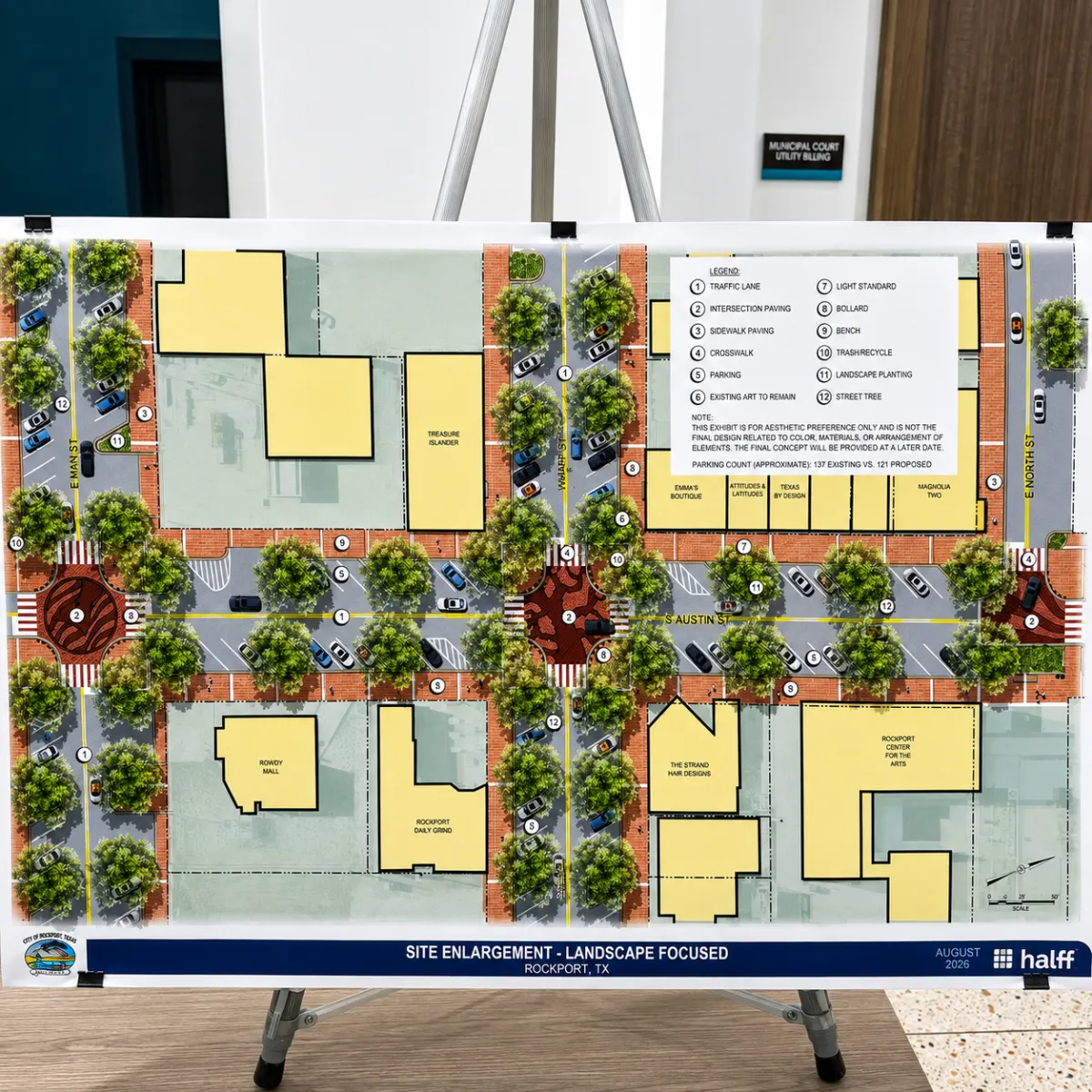
Development Services Director Amanda Torres and planners from Halff Associates have already done their part. Two meetings in, residents have seen real options, not slogans. One concept leans into trees and landscaping. The other leans into parking. What the public said at the first meeting has been turned into something concrete enough to accept, reject, or change. That is how this process is supposed to work.
Now it is the public’s turn.
Street trees for shade. Permeable pavers and better stormwater handling. Intersections that look like the coast instead of anywhere else in Texas. Those are not decorations. Austin Street floods, bakes in summer, and is the face of downtown. Trees, drainage, and parking will decide how the street works and how it feels for decades.
Torres put the standard simply: a design “that the community would like to see.” That only happens if the community says so, in person or by email, before the window closes.
Public Works Director Ryan Picarassi was more blunt. “Downtown is our downtown, not the city’s downtown,” he said. “It’s the people who live here in Aransas County and Rockport.” That is not a courtesy line. It is the reason this process fails if residents stay home.
The feedback he described pulls in a different direction from the landscape concept getting the most attention: more parking, medians removed to open downtown, more lighting, wider walkable sidewalks. Drainage came up too, and Picarassi was honest that those fixes are not yet in the drawings. His team is asking how the street functions for people walking and driving through it. That question matters as much as how the street looks.
Two directors, two angles, and the same admission from both: the city has not already decided. Contemporary, modern, or coastal are all still on the table. Style, Picarassi said, does not belong to the city. It belongs to whoever shows up and speaks.
The most honest question in these meetings is how Rockport grows without losing itself. There is no planning trick that answers that automatically. Alignment with the downtown master plan and the heritage district overlay helps keep new work honest to old commitments. Paperwork will not save Rockport’s character if residents check out now and object later, after City Council has already voted on a final design.
If shade, drainage, and coastal details sound like the Rockport worth keeping, say so. If parking matters more to daily life on that street, say that instead. Silence is a choice. It is the choice that lets the loudest voices in the room win by default.
Missing a meeting does not lock anyone out. Torres has said she will send the presentation to anyone who asks. Comments can go directly to her at [email protected]. That is a low bar for a project that will outlast every meeting held about it.
Austin Street is going to change. The only open question is whether it changes according to what Rockport actually wants, or according to who bothered to weigh in while it still counted. Do not wait for City Council’s final vote to have an opinion. By then, the opinion that matters will already have been the public’s — or it will have been nobody’s.