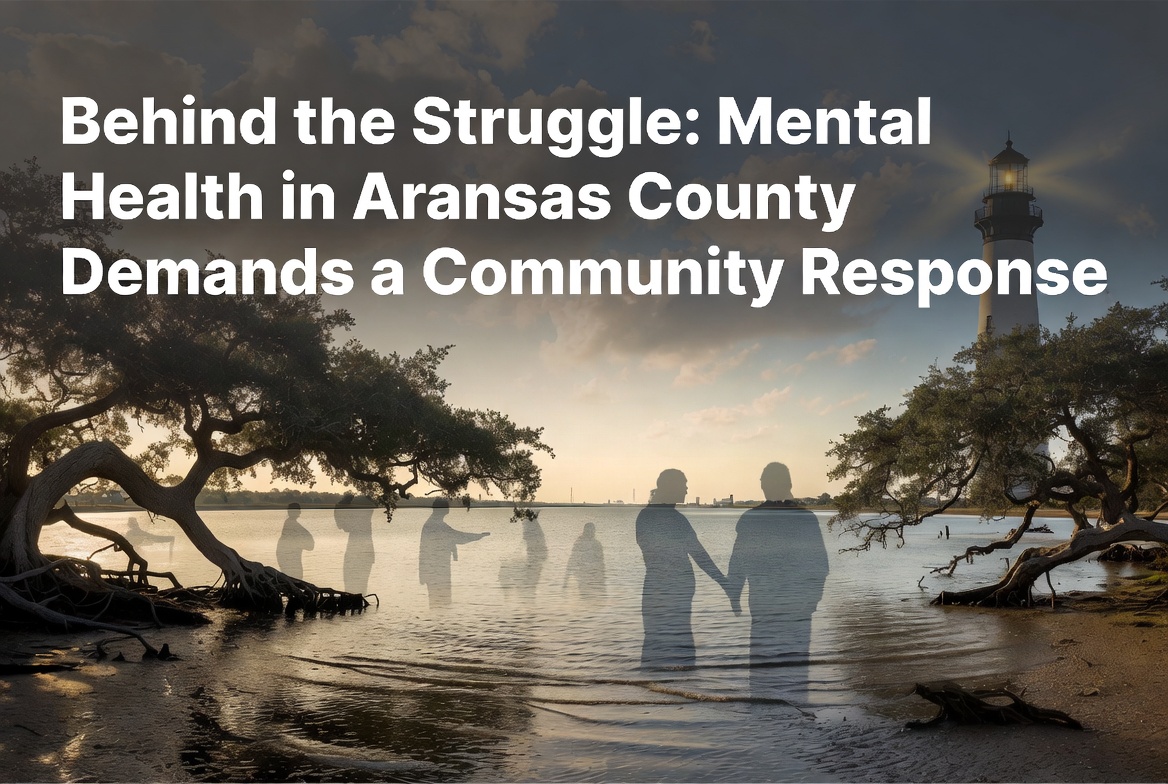
Behind the Struggle: Mental Health in Aransas County Demands a Community Response
Walk down any street in Rockport on a Tuesday afternoon, and you will see the postcard version of this county. Pelicans. Charter boats. Salt air. A community that takes pride in its resilience.
But behind that coastline is something harder to photograph. It is a mother who has not slept in three days because her adult son is in crisis, and the nearest inpatient psychiatric bed is in Corpus Christi. It is a veteran who came home from overseas carrying invisible wounds and cannot find a counselor within 40 miles who accepts his insurance. It is a schoolteacher who has been quietly managing severe anxiety for two years without any professional support because she cannot afford to miss work and does not know where to turn.
Mental illness is not a condition that visits Aransas County from somewhere else. It lives here. It has for a long time. What has not kept pace is the community's willingness to talk about it honestly, and the infrastructure needed to meet it.
According to the Kaiser Family Foundation, more than 34 percent of adult Texans reported symptoms of anxiety or depression as of late 2021, exceeding the national average of 31.6 percent. Before the pandemic, that figure in Texas was closer to 17 percent. The increase was not gradual. It was a rupture.
For rural coastal counties like Aransas, those numbers carry added weight. Research from the Rural Health Information Hub confirms that one of the most significant barriers preventing rural Americans from receiving mental health care is a shortage of qualified providers willing to work in small, geographically isolated communities. When local services are unavailable or overwhelmed, healthcare professionals are left referring patients to facilities outside the community, which often means those patients never make it to care at all.
Only about one-third of the mental healthcare needs of Texans are currently being met statewide, according to KFF reporting. That means the majority of people in this state who need professional support are not receiving it. In a county the size of Aransas, with approximately 26,000 residents and limited public transit, that gap is not a statistic. It is a neighbor.
Aransas County sits within the South Texas Behavioral Health Region served by Tropical Texas Behavioral Health, which covers the OSAR, or Outreach, Screening, Assessment, and Referral system for mental health and substance use services. That coverage area spans 19 counties across a vast stretch of South Texas. The reach is broad. The resources are thin.
The county's own detention center on Highway 35 North in Rockport books an average of 212 inmates per day and turns over more than half its population each week. Among that population, untreated mental illness is common. The facility provides mental health services as required by state standards, but a jail cell is not a treatment program. Law enforcement officers in this county will acknowledge that, and many do so in private with frustration. Too often, a patrol officer becomes the first and only mental health responder when someone is in crisis, not because deputies and officers are trained clinicians, but because there is no one else to call at 2 a.m.
That reality is not a failure of law enforcement. It is a failure of community infrastructure.
In a small coastal community where everyone knows your name, seeking mental health treatment can feel like a public admission of weakness. That stigma is as real as the treatment gap, and in some ways more dangerous because it is invisible.
According to the most recent SAMHSA National Survey on Drug Use and Health, 48 percent of adults with any mental illness and 30 percent of adults with serious mental illness did not receive mental health treatment in the past year. Among the reasons cited: cost, lack of knowledge about available resources, and stigma around seeking help. All three barriers are present in Aransas County. All three are addressable, but only if the community chooses to address them together.
That work cannot rest on a single county office or a single nonprofit. It requires the involvement of churches, schools, employers, first responders, and families. It requires local leaders to say plainly that mental illness is a medical condition, not a character flaw, and that asking for help is not a weakness. It requires the willingness to fund what we say we value.
Communities that have made measurable progress on rural mental health have not done so by waiting for a state program to arrive. They have built local coalitions between health providers, schools, law enforcement, faith communities, and county government. They have trained non-clinical community members in Mental Health First Aid, a nationally recognized program that teaches ordinary people how to recognize a crisis and connect someone to help before that moment becomes catastrophic.
They have also invested in telehealth infrastructure. For a county like Aransas, where the drive to a major medical center is 30 to 45 minutes on a good day, telehealth is not a convenience. It is a lifeline.
The Aransas County Commissioners Court has the authority to prioritize behavioral health in the county budget. Local employers can offer meaningful employee assistance programs. The school district can expand counselor ratios and crisis intervention training. Hospital staff at Rockport's local healthcare facilities can build clearer referral pathways so that someone presenting in the emergency room in crisis is not sent home with a pamphlet.
None of these solutions requires waiting.
Mental health in Aransas County is not someone else's problem to solve. It belongs to all of us because the cost of inaction is paid by all of us, in emergency room visits, in incarceration, in lost productivity, in families that quietly fracture when they cannot get the help they need.
The people in this county who are struggling are not strangers. They are the people who bag groceries, who teach kindergarten, who crew the charter boats, who show up to church on Sunday morning holding it together as best they can. They deserve a community that meets them with resources and respect, not silence and shame.
Aransas County has proven it can rebuild after a hurricane. It can do the same for the mental health of its people. The only question is whether we are willing to start.
Crisis Resources: Tropical Texas Behavioral Health Crisis Line: 1-800-377-3639 SAMHSA National Helpline: 1-800-662-4357 (free, confidential, 24/7) 988 Suicide and Crisis Lifeline: Call or text 988