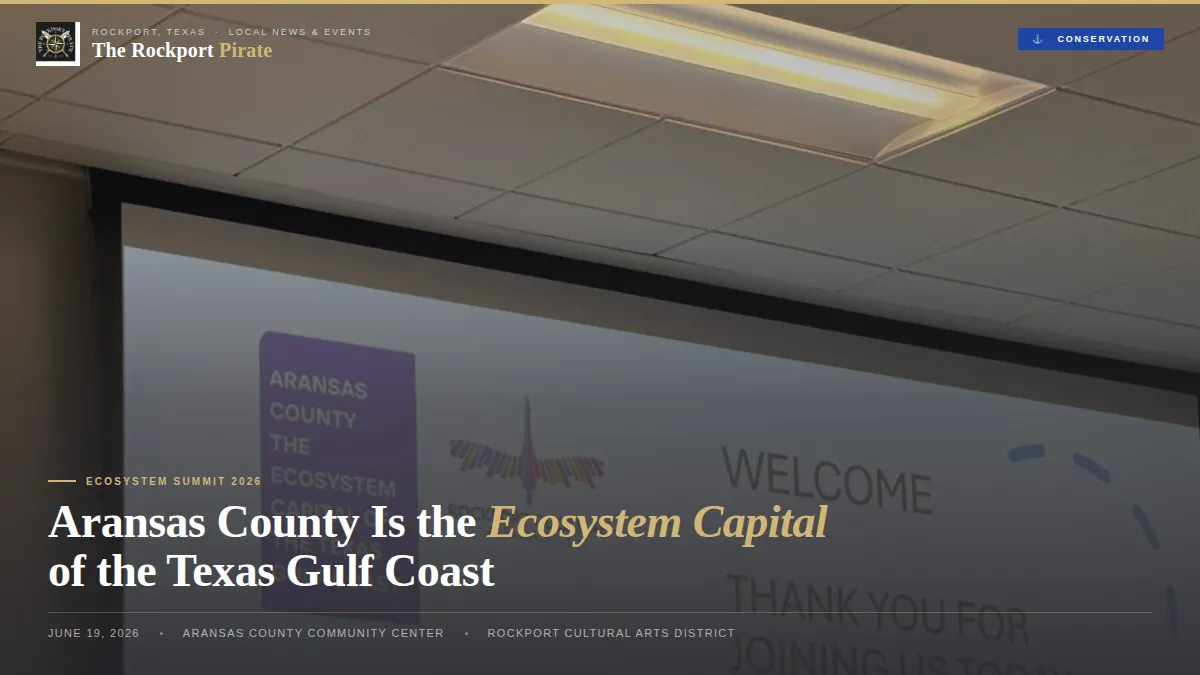
Aransas County Declared "Ecosystem Capital of the Texas Gulf Coast" at This Year's Ecosystem Summit
A full day of film, science, and community voices makes the case for why conservation and culture go hand in hand here on the coast.
If you've ever stood at the water's edge in Rockport and felt like you were somewhere truly special — you were right. And last week, a room full of scientists, artists, ranchers, oyster farmers, birders, kayakers, land trust advocates, and community members gathered to make that case in a big way at this year's Ecosystem Summit, hosted by the Rockport Cultural Arts District.
The event opened with a proclamation that's been a long time coming: Aransas County — along with the City of Rockport, the Town of Fulton, and the Aransas County Navigation District — has officially been declared the Ecosystem Capital of the Texas Gulf Coast. It's a tribute to the many dedicated conservation organizations that call this area home, and an acknowledgment that what we have here is worth protecting, celebrating, and yes, fighting for.
Art and Ecosystem: An Old Partnership
The Cultural Arts District didn't stumble into hosting this summit — it was a natural fit. Rockport has been a magnet for artists since the 1940s, drawn here by the same windswept oaks, bountiful bays, and inspirational coastline that have long made this place an ecological gem. The two have always been connected.
The day included screenings of two documentaries produced by board member Carla Tank: one on the Rockport-Fulton art colony's sporting and wildlife legacy, and another — Aransas Living: A Legacy — honoring the lifetime conservation work of local legend Charlie Belair. When Charlie was asked to raise his hand so the room could recognize him, it felt like a standing ovation waiting to happen.
Marine biologist and wildlife artist Dinah Bowman, who has called this area home since 1968, captured exactly why art and ecology belong together. From illustrating the first-ever published images of normal trout and redfish development at the Marine Science Institute to pioneering the Japanese fish-printing technique gyotaku right here in Texas, Dinah has spent 57 years at the intersection of science and beauty. "Art brings the romance," she told the room, "but it also brings education — and that combination is what moves people to care."
She wasn't wrong. She reminded everyone that even the culinary arts shape conservation: Paul Prudhomme's blackened redfish recipe single-handedly drove redfish demand so high it changed fishery management in Texas.
The Science of Saving What We Have
Keynote speaker Kathy Sweezy, Coastal Restoration Project Director for The Nature Conservancy in Texas, brought the science — and made it accessible, urgent, and hopeful all at once.
TNC has been operating for 75 years across 83 countries, and in Texas alone they've restored 165 acres of oyster reef. But Kathy's presentation wasn't just about what TNC has done — it was about what all of us can do together.
She walked through the Texas Wetland Action Mapping (Texas WAM) plan, the state's first-ever tidal wetland protection plan developed through a community-driven, stakeholder-led process. Over 34 organizations helped shape it, identifying 17 action areas along the Texas coast — including one right here in our backyard. The plan identifies the potential to protect up to 342,000 acres of wetland and 567,000 acres of wetland migration space.
"Together we can find a way" wasn't just a closing line — it was the through-line of her entire talk.
She also highlighted the cascading power of oyster reef restoration, noting that a single oyster can filter 50 gallons of water a day, that restored reefs provide habitat for over 300 marine species, and that Half Moon Reef — TNC's first large-scale restoration project — has generated an estimated $1.3 million annually in economic activity. And the 10-year monitoring report she just received? "It's looking great," she said with a grin. Don't tell anyone yet, she joked — it's not final.
Oyster Farming: Where Conservation Meets Commerce
Amy Belair — yes, Charlie's daughter, and a conservation biologist by training — co-founded Big Tree Oyster Company in northern Copano Bay in 2023 with her husband Seth Gamble. They're part of a growing fleet: as of early 2025, there are 13 permitted oyster farms in Texas, and nine of them are right here in Aransas and Copano Bays.
"More oysters means a healthier coast — full stop," Amy said.
Texas was the last state to embrace oyster aquaculture, but it's catching up fast. In 2025, Texas farms harvested 5 million oysters with an estimated $1.9 million in revenue. The farms require no chemicals, no feed, no negative inputs — just bay water and a whole lot of care. And they attract life: Amy's five-year-old son Cooper once caught six different species of fish right off their farm in a single afternoon.
The oysters coming out of this region are also turning heads at Michelin-starred restaurants in Austin, Houston, and San Antonio. Right here at home, you can taste the difference at local spots like Copano's on East North Street, Charlotte Plummer's in Fulton, Gabriela's Seafood + Tapas, and The Boiling Pot — all of which feature locally sourced Gulf seafood. As Amy put it, the oyster takes on the flavors of where it's grown — so every Aransas Bay oyster is, in a very real sense, a taste of this place.
Pathways, Birding, and Getting Outside
Dr. Rebecca Rylander, Birding Chair for Aransas Pathways and Science Coordinator for the Rio Grande Joint Venture under the American Bird Conservancy, reminded the room just how rare this place is for birds. Texas has nearly 700 bird species on record. Whooping cranes are just 10 minutes up the road. The Ruby-throated hummingbird migration brings thousands of birds through every fall.
Nationwide, almost 100 million people bird watch — generating nearly $15 billion in economic activity annually. Rockport and Fulton are positioned to capture a significant piece of that.
Jim Farnsworth, Kayaking Chair for Aransas Pathways, shared some exciting news: Aransas Pathways has now been approved by Texas Parks and Wildlife for a 30-mile paddling trail connecting sites from Cavasso Creek all the way through Saint Charles Bay and Lamar, with loops of varying distances to suit everyone from first-timers to serious paddlers. A submission is also pending for three loops around Little Bay — including a route that starts right by the cultural interface sculptures near the big crab.
Land Stewardship and What's at Stake
Steve Ferguson, Chair of Aransas County Land Use Management, shared updates on the Texas Master Naturalist Mid-Coast Chapter's 346 members who have logged over 266,000 volunteer service hours since the program began — equivalent to about $7 million in service in 2023 dollars. He also announced that a new high school naturalist program at Rockport-Fulton High School, designed for juniors and seniors, just completed its first full academic year and is ramping up for 2026-27.
"The theme is teaching science by doing science," Steve said. The kids love it. And when a 20-something doctoral student spoke at their commencement ceremony, the students lit up in a way they just don't for grandfathers like him — which he took, graciously, as a lesson in how to reach the next generation.
Janae Evans, President of Aransas First Land Trust, announced that after years of slow but steady progress, the organization has nearly 400 acres under conservation. She also shared that they worked with Representative Todd Hunter to secure a $1 million appropriation through the 89th Texas Legislature via Texas Parks and Wildlife — and they're close to closing on a 33-acre parcel adjacent to the Aransas Woods property.
And then, barely containing herself, she hinted at something bigger: a high-conservation-value property — one that "everybody in this room knows" — that could come under protection if a roughly $1.2 million funding gap can be closed. She's not ready to name it yet. But stay tuned at aransasfirst.org.
The Bottom Line
This county has something rare: a community of people who have been fighting for this ecosystem for decades — and a new generation ready to carry the torch. The Ecosystem Summit was one long, clear argument that our bays, our birds, our oysters, our Live Oak forests, and our coastline aren't just beautiful. They're the reason people come here. They're the reason people stay here. And they're worth every ounce of effort it takes to protect them.
As one panelist put it near the end of the day: "You don't inherit this land from your ancestors. You borrow it from your grandchildren."
Aransas County — the Ecosystem Capital of the Texas Gulf Coast — is borrowing wisely.